SHOW YOUR WORK
To my students. Someone encounters your work:
Most people won't have any context for what they are seeing. Your work won't automatically appeal to them aesthetically or intellectually. They may not be curious enough to attempt to unpack the work on their own. Even your faculty in school - who should be curious and willing to interpret your work based on their own lived experience - probably won't have the complete context needed to fully appreciate what they are encountering. This presupposes that there is substance, depth and actual effort in your work... and for the moment we'll assume there is.
For your faculty, as well as future curators, gallerists, critics, grantors, collaborators and collectors, it is in your interest to "show your work," just as you would show your grade school math teacher how you reasoned through a problem. Being articulate about your process, your intentions, and your research sources provides some much-needed context for your faculty at they consider which questions and comments might help you find other productive paths. For example, "if you modify your process in this way, you can test out variations on this idea faster." Or, "look at so-and-so's body of work so you build upon a shared idea rather than re-invent the flat tire." And there ends the math problem metaphor.
This isn't about proving you have the correct solution (art is about questions, not answers,) or solving a problem (that's didactic propaganda,) or demonstrating how clever you are (nobody cares.) It's about creating entry points into your work for other people so they can find theier way in, wander around, and form their own feelings, opinions and ideas. Most of the time they still won't like your work, but that's not your problem. You've done your due diligence.
What happens when your faculty doesn't "like" or "get" the work you are making? This question is just a special case of, "what if the world doesn't get my work?" The job of faculty is not to like or dislike a student's work, but to determine the depth of engagement in the work you are doing (are you really committed or killing time?), to give you pointers to a more productive studio practice, to strengthen your technical muscles, and to encourage you on your journey to understand your unique creative impulse and where it intersect with the rest of the work. Honestly, most faculty don't care about specifically what you make, but rather the intensity of your engagement in the creative practice. That intensity is implicit in the finished work, and explicit when you "show your work.”
Most people in the world are not your parents: they aren't magically enchanted by every poop you make and won't tell their friends how talented and creative and cute your poop is. Most work of any substance won't instantly capture strangers' imaginations. Some work is obviously technically masterful and many viewers are awed by that and go no further. Some work can pander to popular sentiments - there's porn for every kink. And neither of those enchantments are inherently "wrong." They can in fact be the enthusiasms that get an artist out of bed in the morning, excited to make something new. But if that's as far as one goes, then the work becomes formulaic, easily repeatable, and dead (lacking growth.) And if that's all that excites you when you get up in the morning, great, and save yourself a zillion dollars by not going to art school. Use the money to buy an investment property and travel the world on the income.
Most art that I've ever encountered doesn't turn me on at at first sight. And a few things that did lost their shine on deeper thought, longer looking, and some research. And a few of the things that enraged me at first blush have yielded rich rewards decades later. For example, In the late 1980s I viewed Ellsworth Kelly's paintings with utter and absolute contempt. That a shaped canvas painted with a single, strokeless color could be considered a "painting" was in my opinion the emperor's new clothes. While I appreciated minimalism in music (Steve Reich, Terry Riley, Phillip Glass) it left me cold in the areas of visual and sculptural art.
But around 1996 a number of exhibitions of his work appeared concurrently in New York, and as I remember it, an issue Artforum contained a special section of essays to commemorate the moment. One essay in particular dwelt upon his studio, and described his practice of clipping images that struck his eye from newspapers and magazines. In any given clipping he would see a primary shape, and from that he would iterate drawing after drawing, refining that shape. I recognized the process, and have not looked at his work the same way since. After 9/11 he made a proposal for the site of the leveled World Trade Center. Kelly took the front page of the New York Times, which showed the footprint of the site from an oblique birds-eye view, and simply painted a green trapezoid, reopening the space to infinite possibility within its bounds.
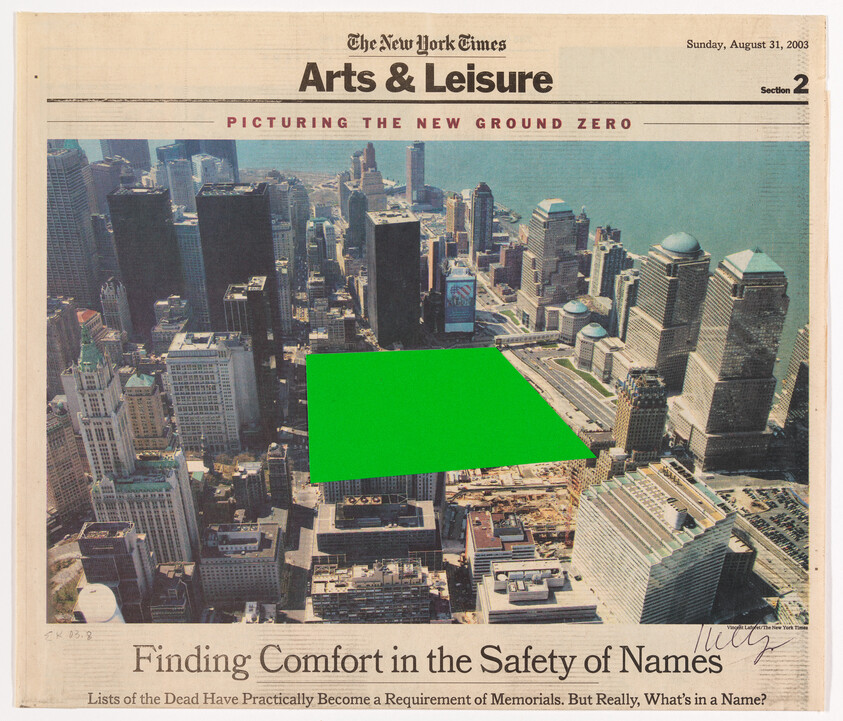
Ellsworth Kelly, Ground Zero, 2023, Collage on newspaper, Sheet (Irregular): 11 9/16 × 13 1/2 in. (29.4 × 34.3 cm), Gift of an anonymous donor.
Postscript.
I had a couple of conversations last week with artist/professor/colleagues Michele Carlson and Siobhan Rigg that touched in different ways on the notion of "showing your work," particularly with respect to how we encourage our students to do that. It's lifesaving to have trusted thought partners. I pondered those conversations in light of my own experiences as a student, practicing artist and art professor as I was walking away from Strand bookstore this morning. In my hand was a freshly purchased copy of a monograph devoted to Kelly's collages. I stumbled on it accidentally after had been looking for the book for a couple of years and forgotten about it. I discovered his collage work in preparation for a show I curated a few years ago, and have been thinking about them again for another show I want to curate in the near future.
Forty years ago Kelly would would not have entered my thinking, much less influenced my creative practice. But being open to new data, constantly revisiting my old assumptions and biases, checking Kelly's work has opened me up to rich veins of thought for me to pursue.
Written on the morning of 16 August, 2026 as I was walking around the West Village. An edited version of this is published on the Holler Substack.
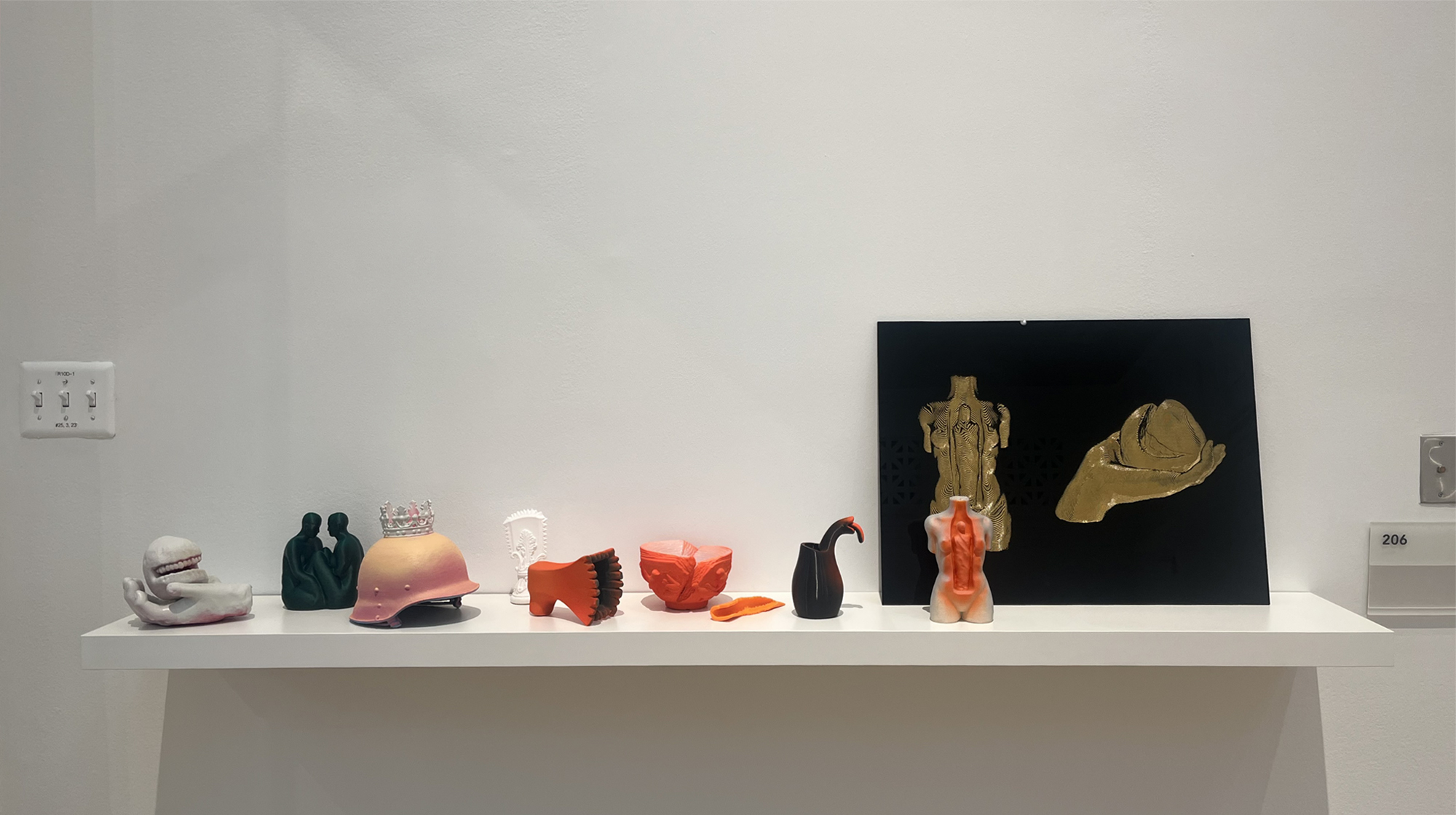
install shot from "A Gift in Motion"
I have an abundance of abundances... frustration, restlessness, grief, unused titles, etc.
Writer's block, or its equivalent for visual artists, is not a problem I've had for decades. I maintain lists in abundance: of experiments I want to conduct, shows I want to curate, artists I want to work with, and so on. So if for example, I'm not sure what to do next in the studio, I just look at the list of experiments I want to try out, and start with the item that most strikes my fancy at that moment.
And, several years ago, I realized I'd accidentally used the same title more than once. So I started keeping a list that included both unused and used titles. Whenever I can't think of something for a new piece, I can just find one that feels right in the list. And whenever I think of, or hear something that sounds GREAT, I add it to the list. So for example, the letter 'R'...
radiant darkness
radiant monument
√ rainbow table
rainy day in northern europe
rampant or recumbent?
Ravel was the soundtrack to his mid-70’s metrosexuality
√ real people living unreal lives
real time monument
real toads in imaginary gardens
received images
recreational mathematics
redecorator
redshifting to heaven
refresher
√ rehab for men
relational decay
remote control camel spanker
√ rental
requirement already satisfied
reshuffling effect
resting suicide face
resplendent ego
restoration
resurrection room
retronet
Richard Nixon Is Not the Father of My Child
robot bibles
√ Rock Conference
rubberbound
rubbernecking
(The items preceded by √ are used titles.)
wall label I wrote a few mornings ago for an exhibition next month, "A Gift in Motion," at the Corcoran next month
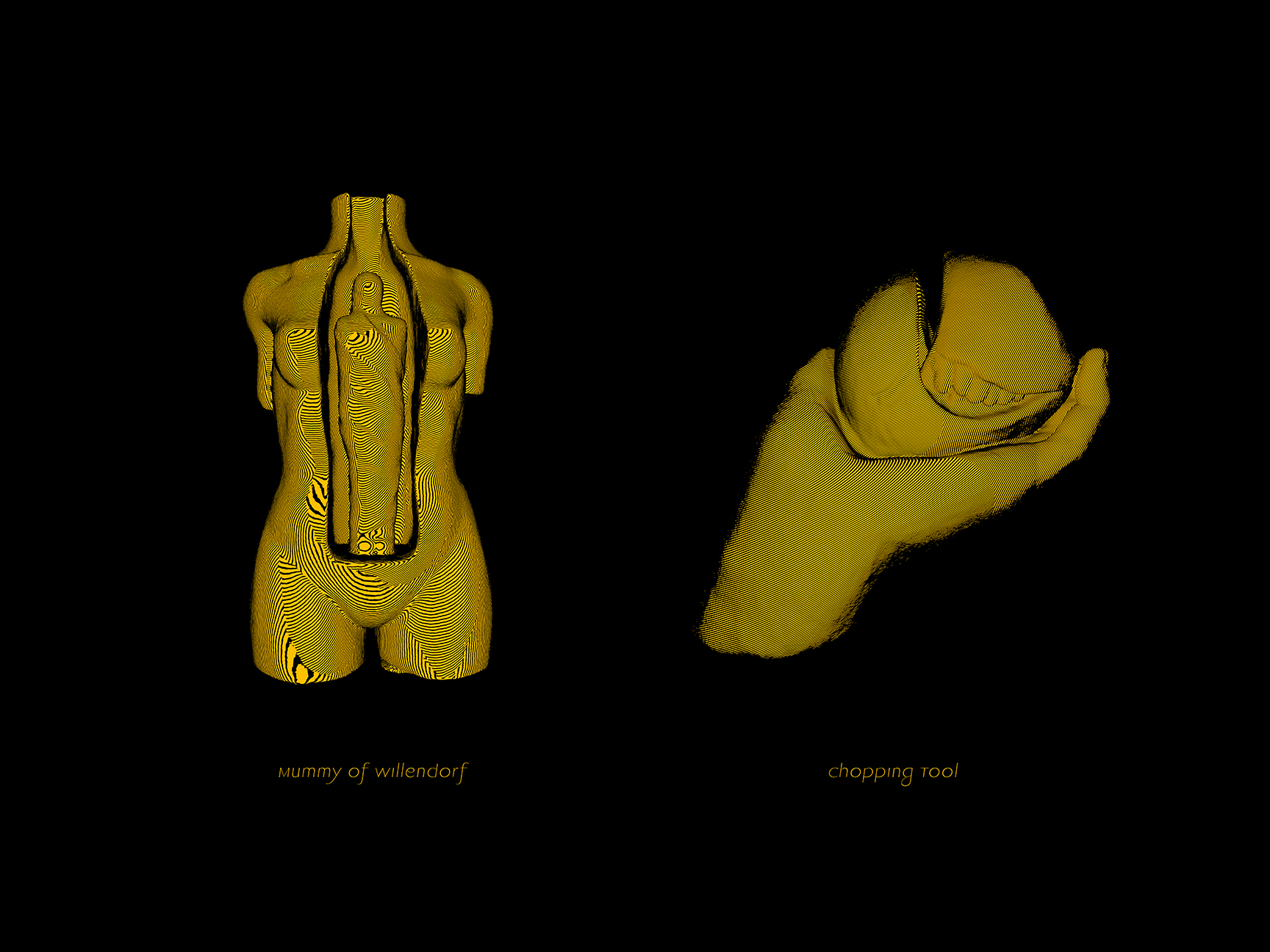
in-progress, from a history of the world in 100 objects

in-progress, from a history of the world in 100 objects
It's 80° and 75% humidity in DC.
The best place to escape DC's oppressive heat and humidity in the summer of 1985 was the Smithsonian American Art Museum (then named National Museum of American Art). I'd go several afternoons a week, and spend a few hours walking a route that included four artworks. I'd regularly visited those pieces prior to that summer, and would continue to revisit for years. Rehangs in more recent memory have reduced that to only one currently on view (at least that I've seen recently.)
I couldn't explain my fascination then, and still can't really, for Blume's "Vegetable Dinner," but that enduring mystery is why I still want to live with it, to go to that place. It has all of the humidity and impending late afternoon cloudburst that I was evading plus attractive ladies around a table preparing a savory meal likely seasoned with savory gossip. For whatever reason I've always mis-remembered the title as, "The Potato Peelers."
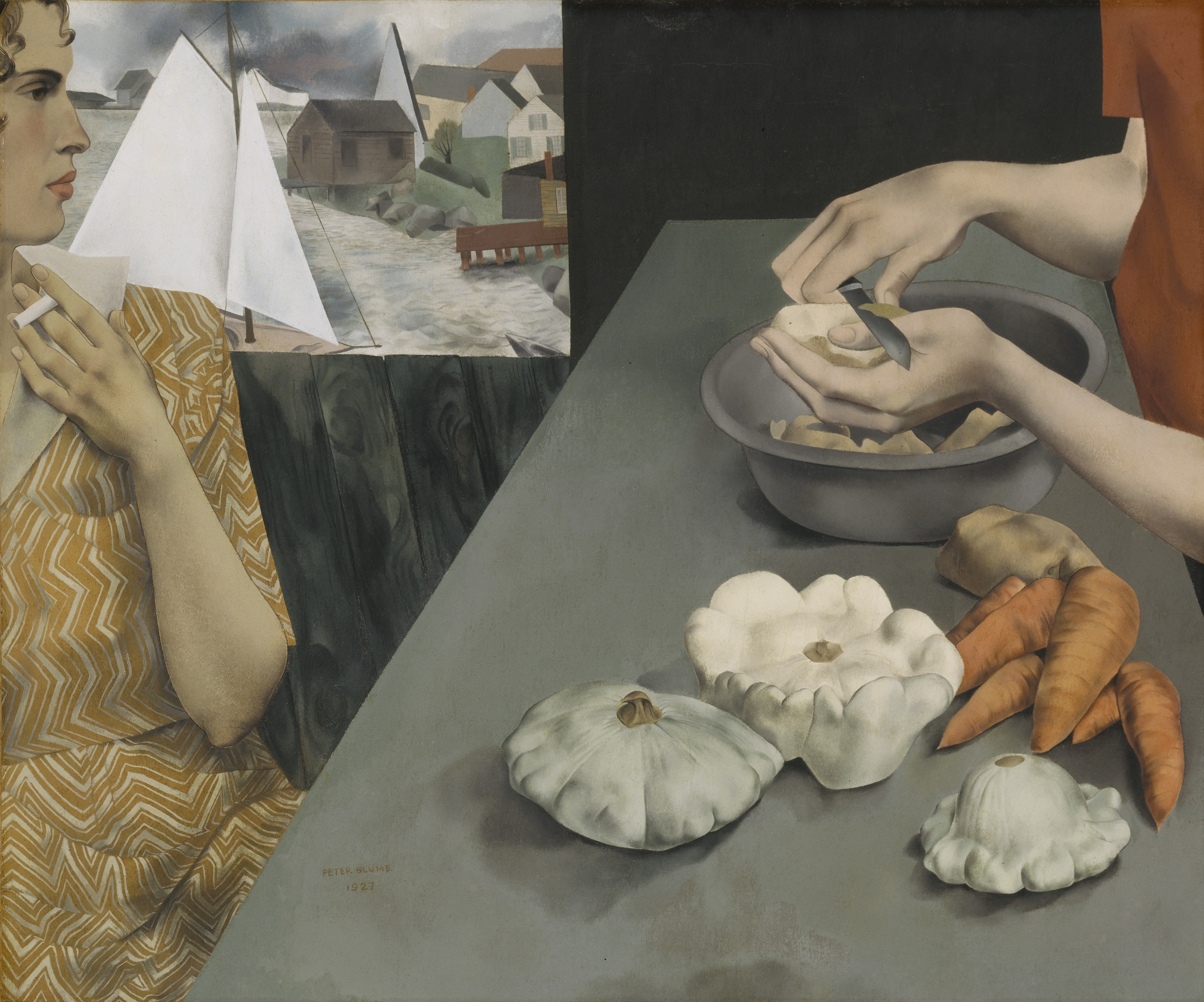
Peter Blume, Vegetable Dinner, 1927, oil on canvas, 25 1/4 x 30 1/4 in. (64.2 x 76.8 cm.), Smithsonian American Art Museum, Museum purchase, 1984.101
Before the before afternoon storm, was the blistering noon sun that melted roofs, bubbled aluminum paint and overexposed everything. Hopper could show it to you, but Kline could make you feel the white-hot slam dancing rage in your bones.
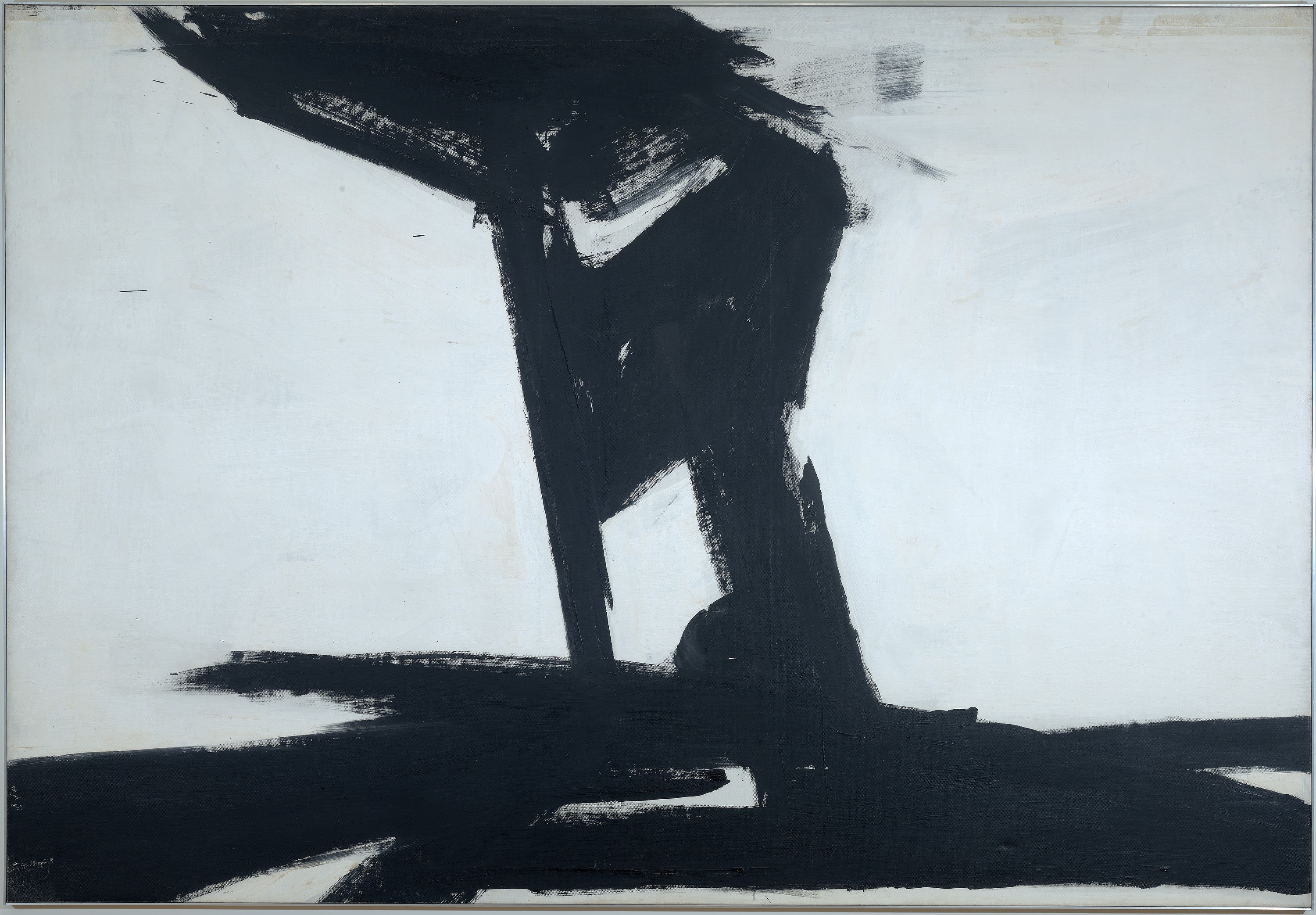
Franz Kline, Untitled, 1961, acrylic on canvas, overall_2: 72 1/2 in. × 106 in. (184.2 × 269.3 cm) frame: 73 1/4 × 106 5/8 × 1 1/2 in. (186.1 × 270.8 × 3.8 cm), Smithsonian American Art Museum, Museum purchase from the Vincent Melzac Collection through the Smithsonian Institution Collections Acquisition Program, 1980.5.1
And then the impending storm again. Diebenkorn's acrid turpentine clouds drip with humidity. I've never felt the clouds in this, or in the Blume painting, to be ominous. Rather, they anticipate an auspicious event that connects me to a much larger, majestic universe.
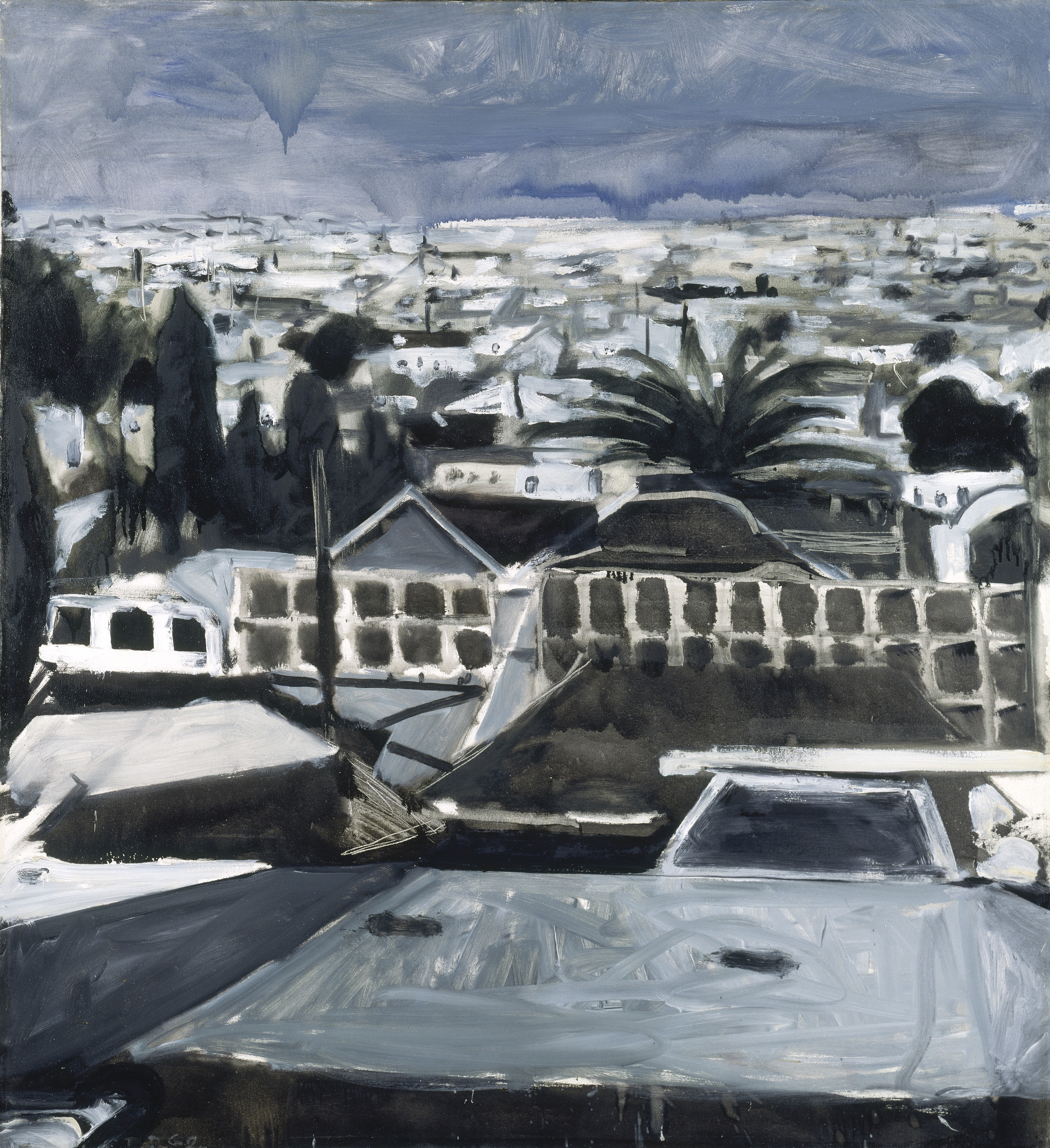
Richard Diebenkorn, View of Oakland, 1962, oil on canvas, 58 5/8 x 53 7/8 in. (149.0 x 137.0 cm), Smithsonian American Art Museum, Gift of S.C. Johnson and Son, Inc., 1969.47.11
Away from the AC-cooled grand marble gallery, deeper in the building was an interior HEAVEN. What the clouds are to the external experience of majesty, James Hampton's are the interior reflection of same.
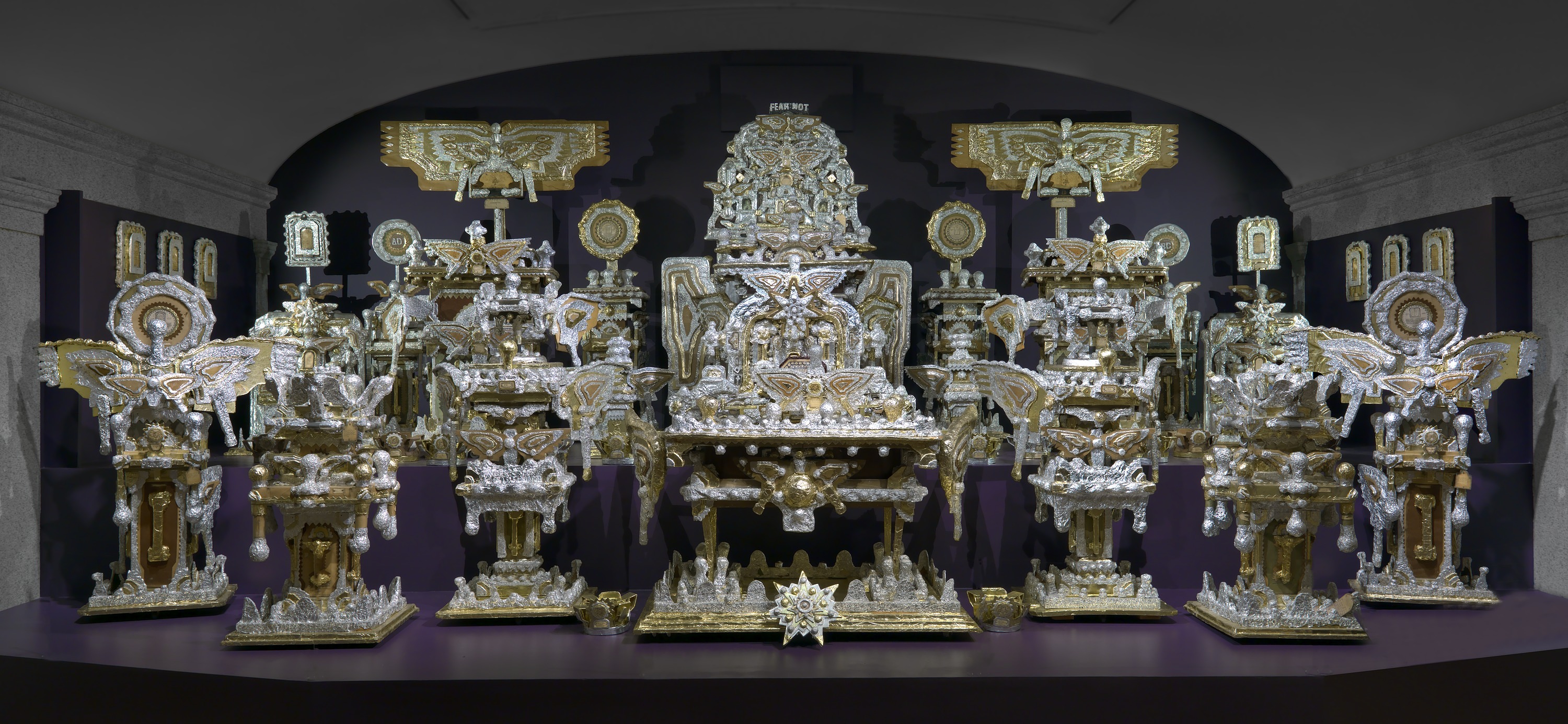
James Hampton, The Throne of the Third Heaven of the Nations' Millennium General Assembly, ca. 1950-1964, mixed media, dimensions variable, Smithsonian American Art Museum, Gift of anonymous donors, 1970.353.1-.134
26/07/21, some writing this morning.
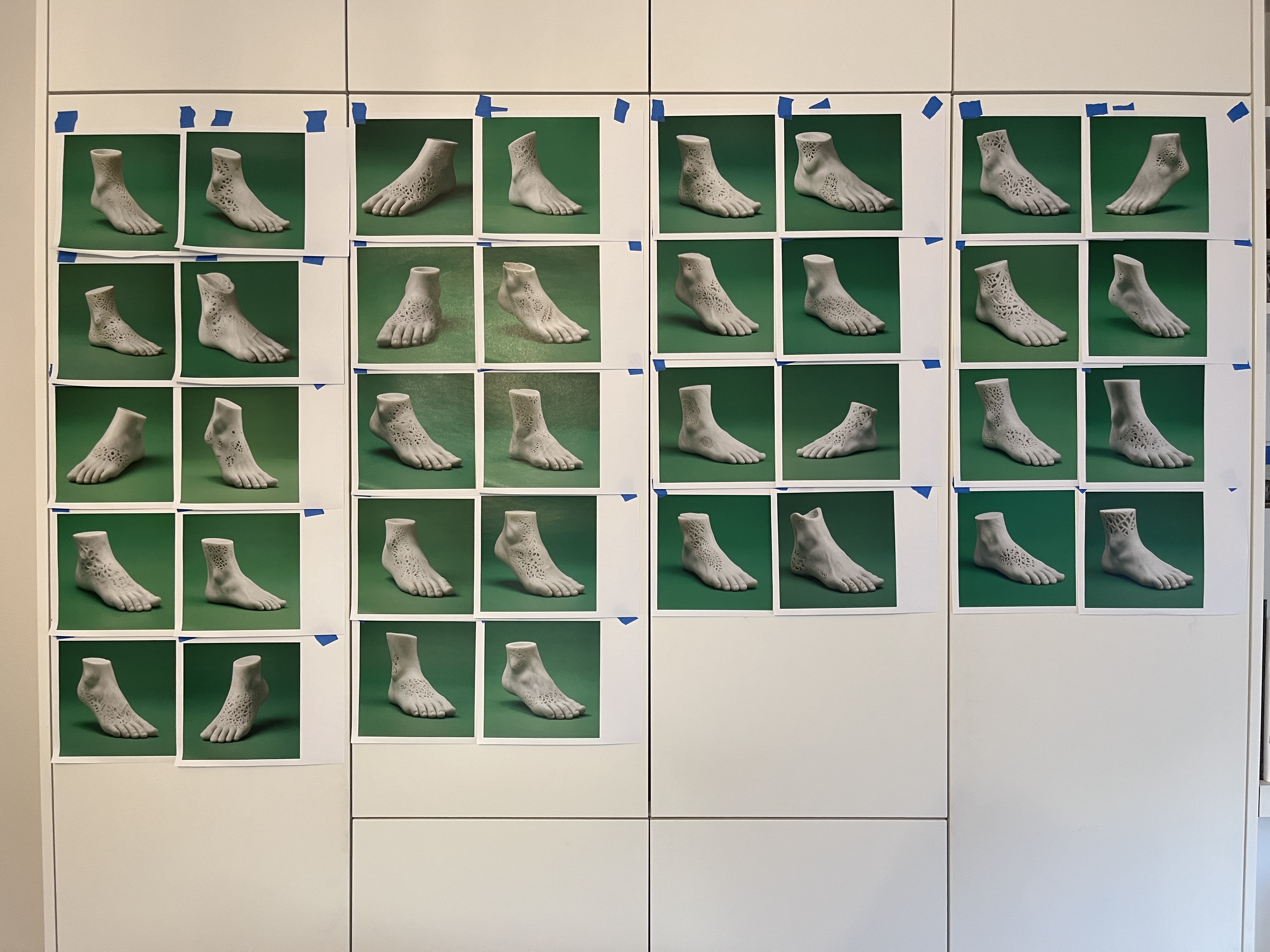
affliction
As a teenager I started exploring the city, ranging into new and strange neighborhoods. It seemed like Cool "Disco" Dan was everywhere a part of the visual fabric, both sides of the river, all four quadrants, all eight wards. I must be mis-remembering, exaggerating, because according to Wikipedia he mostly hit spots along the Red line. His tags - and graffiti in general - spoke to my own rebellion, AND my budding interest in... typography??? The written word is a special case of 'visual phenomena,' and so another ingredient in my picture-making vocabulary (around this time I also had a crush on Barbara Kruger). I never knew Dan Hogg, but I have a childhood friend who did; I think she even commissioned him to tag the garage of her house. He was just a few months younger than I am, but sadly passed away in 2017. I wonder what his ghost or re-incarnation might be tagging in 500 years? In 5000? What language? What handwriting? And with all those ages of memory, what Lutheran manifesto would he tag on which door to authority?
In my first semester of art school I was required (against my will!) to take a writing class. Not something I was looking forward to, as I was there to PAINT. But within five minutes of the first class, it was conveyed to me (possibly through psychic waves) that we were here to use language like colored mud on a canvas, or clay to assemble... ANYTHING. Our teacher was one of the L=A=N=G=U=A=G=E poets, Doug Lang, who insisted on chain smoking for the entire class. He was easygoing and forgiving, but for all that no less challenging or rigorous. On the last day of class he gave us our grades - with typewritten commentary, slipped into a chapbook, "Magic Fire Chevrolet." That was my first real book of poetry. It was in fact a collection of 'concrete' poetry: frustration, rage, and loss conveyed via typewriter and Letraset. This was about a decade before the desktop publishing revolution, but as soon as he could afford a computer he bought one and went NUTS! Doug and I continued to discuss all the important things (and a lot of the unimportant things) until his passing in 2022, and I still have conversations in my head, and wonder what weird language machines he might be experimenting with wherever he is now.
26/05/19, some writing this morning.
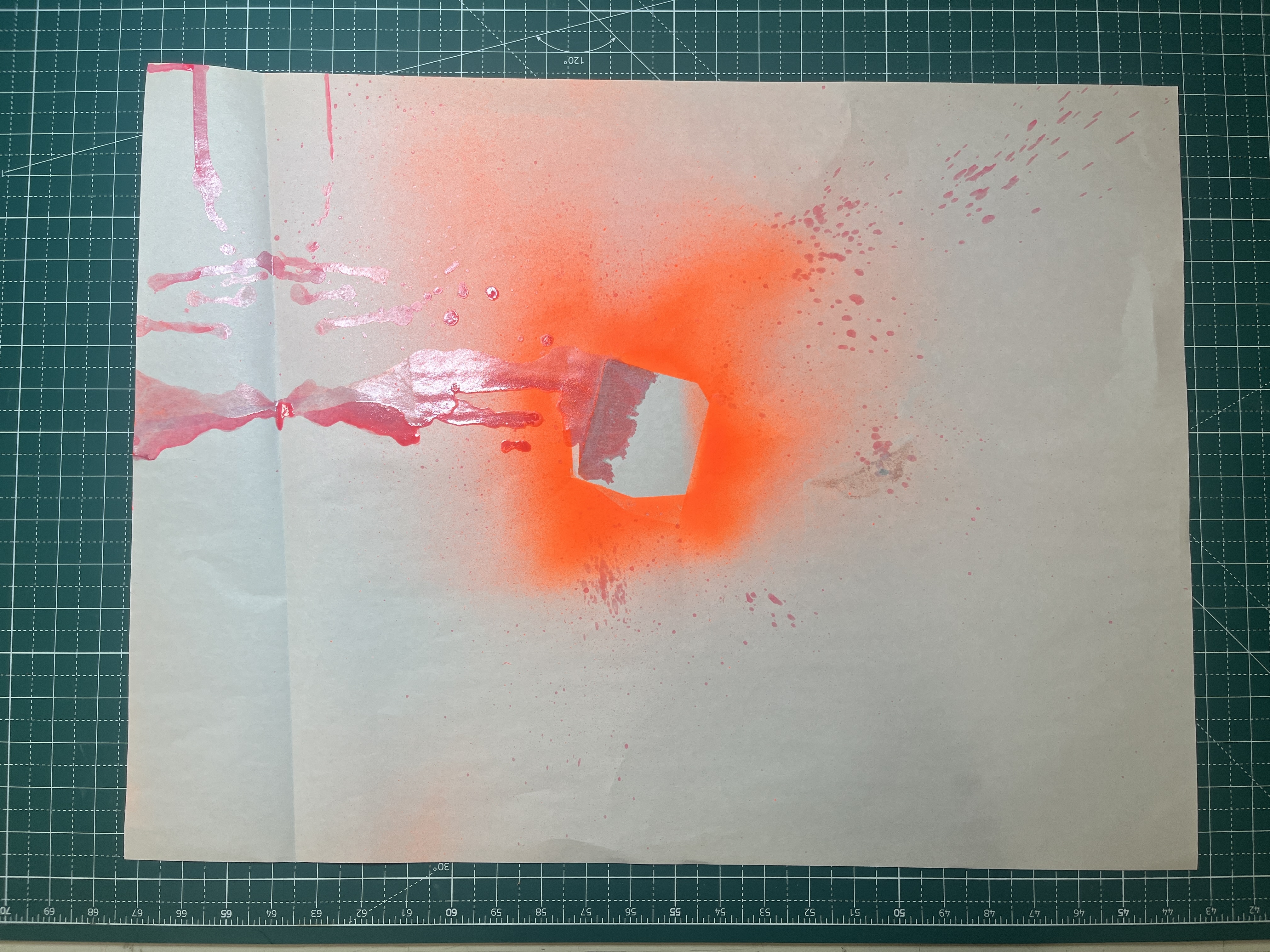
paint
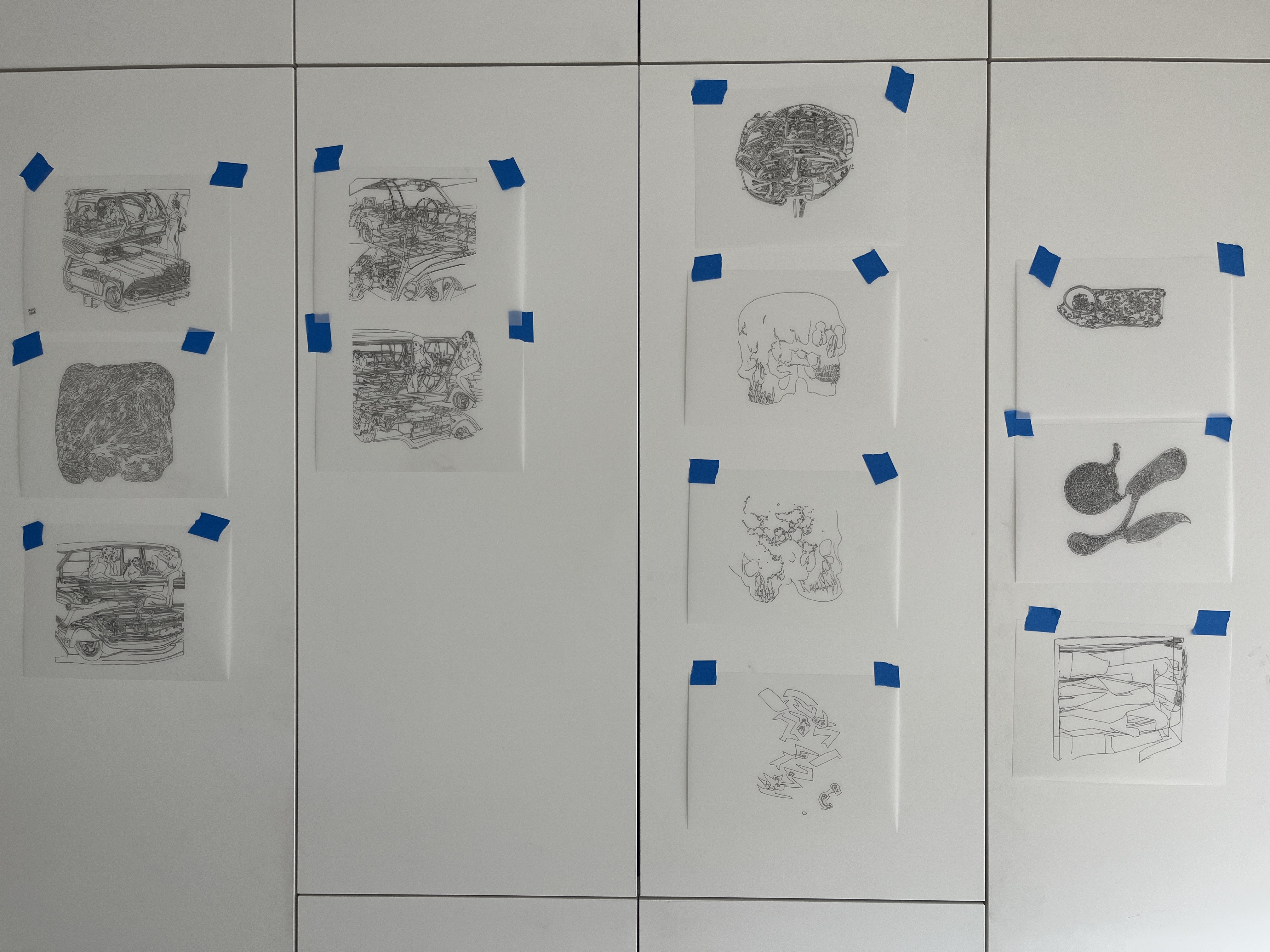
drawings